> For the complete documentation index, see [llms.txt](https://docs.feathery.io/llms.txt). Markdown versions of documentation pages are available by appending `.md` to page URLs; this page is available as [Markdown](https://docs.feathery.io/platform/document-intelligence/edit-extraction-queries-in-bulk.md).
# Edit Extraction Queries in Bulk
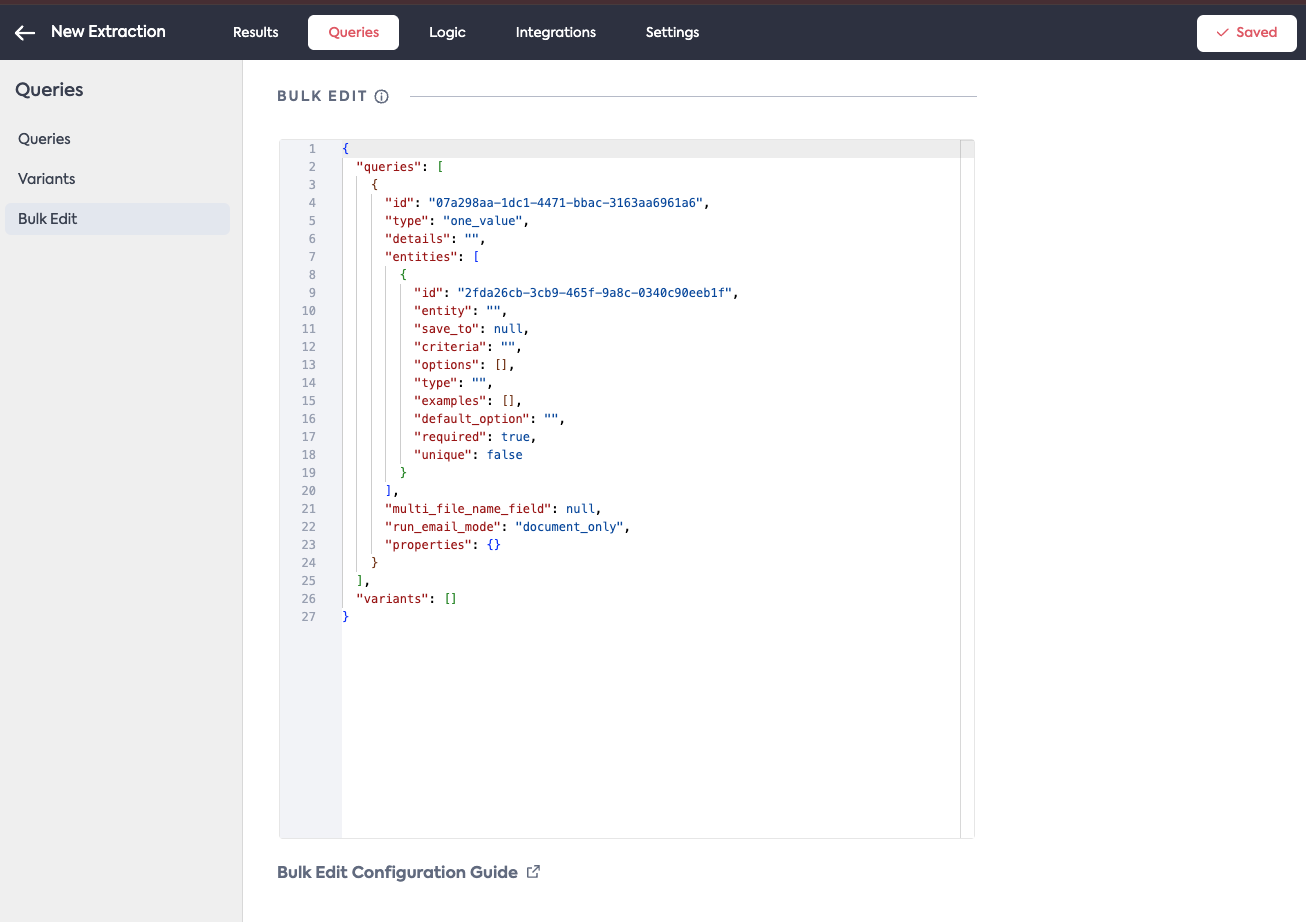
The JSON editor in the Bulk Edit tab for query configuration must follow the provided schema for validation. All fields must be present unless otherwise specified.
Queries
A query defines a single question or instruction in your form. It includes:
* `id`: A unique string identifier.
* `type`: One of the following types:
* **one\_value**: expects one answer
* **multiple\_value**: allows multiple answers
* **cell\_value/column\_value**: extracts values from a spreadsheet
* **yes\_no**: expects a yes/no answer
* **page\_number**: asks for a page number
* `details`: Description or help text shown to the user.
* `multi_file_name_field`: Field that links to file metadata (optional).
* `run_email_mode`: Controls how the result is sent:
* **email\_only**: only email
* **email\_document**: email + document
* **document\_only**: only document
* `toggle_page_question`: Whether to enable a page-specific toggle.
* `entities`: List of items to extract, see "Entities" below.
* `properties`: Additional behavior settings. See below.
* `data_validation_rules`: Rules for checking extracted values (optional).
Entities
Entities are data points you're extracting in each query.
* `id`: A UUID or empty string.
* `entity`: The label or name of the data point.
* `save_to`: Where to store the extracted value.
* `type`: Return type of extracted value. Either use an empty string or one of the following options:
* **freeForm**: any string
* **singleOption**: one of the valid values in the 'options' field
* **number**: value must be a number
* **dollarValue**: value must be a dollar value with currency symbol
* **personsName**: value is a person's name
* **address**: value is an address
* `unique`: Whether the value must be unique.
* `options`: List of valid values (optional).
* `criteria`: Criteria or instruction for extraction (can be empty).
* `examples`: Examples to help guide extraction (optional).
* `required`: Whether this field must be filled.
* `default_option`: Pre-filled or suggested default value.
* `data_validation_rules`: Rules for checking extracted values (optional).
Properties
Optional settings that affect how the query behaves:
* `page_filter_start` / `page_filter_end`: Limits pages the query applies to.
* `page_filter_query`: Keyword-based filter for specific pages.
* `page_limit`: Max number of pages to process.
* `multiple_occurrences`: If the answer can appear more than once.
* `skip_ai_page_filter`: Skip AI-based filtering logic.
* `group_name`: Label to group queries visually or logically (optional).
* `page_filter_whitelist` / `blacklist`: Keywords on pages to include or ignore.
* `page_filter_whitelist_mode` / `blacklist_mode`: Use "AND" or "OR" logic on filters.
Variants
Variants define different mappings for queries to fields:
* `id`: UUID or empty string
* `variant_name`: Friendly name for the variant
* `group_variants`: A list of mappings that connect `question_group_id` to `save_to_fields`
* **question\_group\_id**: Unique identifier matching the query that this variant applies to
#### Where do I find the bulk edit tab?
---
# Agent Instructions
This documentation is published with GitBook. GitBook is the documentation platform designed so that both humans and AI agents can read, navigate, and reason over technical content effectively. Learn more at gitbook.com.
## Querying This Documentation
If you need additional information that is not directly available in this page, you can query the documentation by asking a question.
Perform an HTTP GET request on the following URL with the `ask` and `goal` query parameters:
```
GET https://docs.feathery.io/platform/document-intelligence/edit-extraction-queries-in-bulk.md?ask=&goal=
```
`ask` is the immediate question: it should be specific, self-contained, and written in natural language.
`goal` is what the user is ultimately trying to achieve, the reason they need the answer. Sharing it helps GitBook give you a better, more relevant answer. A goal is most helpful when it describes the outcome the user wants rather than restating the question. For example, with `ask=how do I create an API token`, a goal like `automate deployments from our CI pipeline` lets GitBook tailor the answer to that use case.
The response will contain a direct answer to the question and relevant excerpts and sources from the documentation.
Use this mechanism when the answer is not explicitly present in the current page, you need clarification or additional context, or you want to retrieve related documentation sections.