> For the complete documentation index, see [llms.txt](https://docs.feathery.io/llms.txt). Markdown versions of documentation pages are available by appending `.md` to page URLs; this page is available as [Markdown](https://docs.feathery.io/platform/build-forms/advanced-logic/javascript-rule-builder/reusable-logic-configs.md).
# Reusable Logic Configs
Define globally available logic configurations to use in your Javascript logic rules
If you have variables or configuration that are too large or complex to define in your rules directly, you can leverage **configs** to define that information for your rules to access in an efficient way.
## Set up a Config
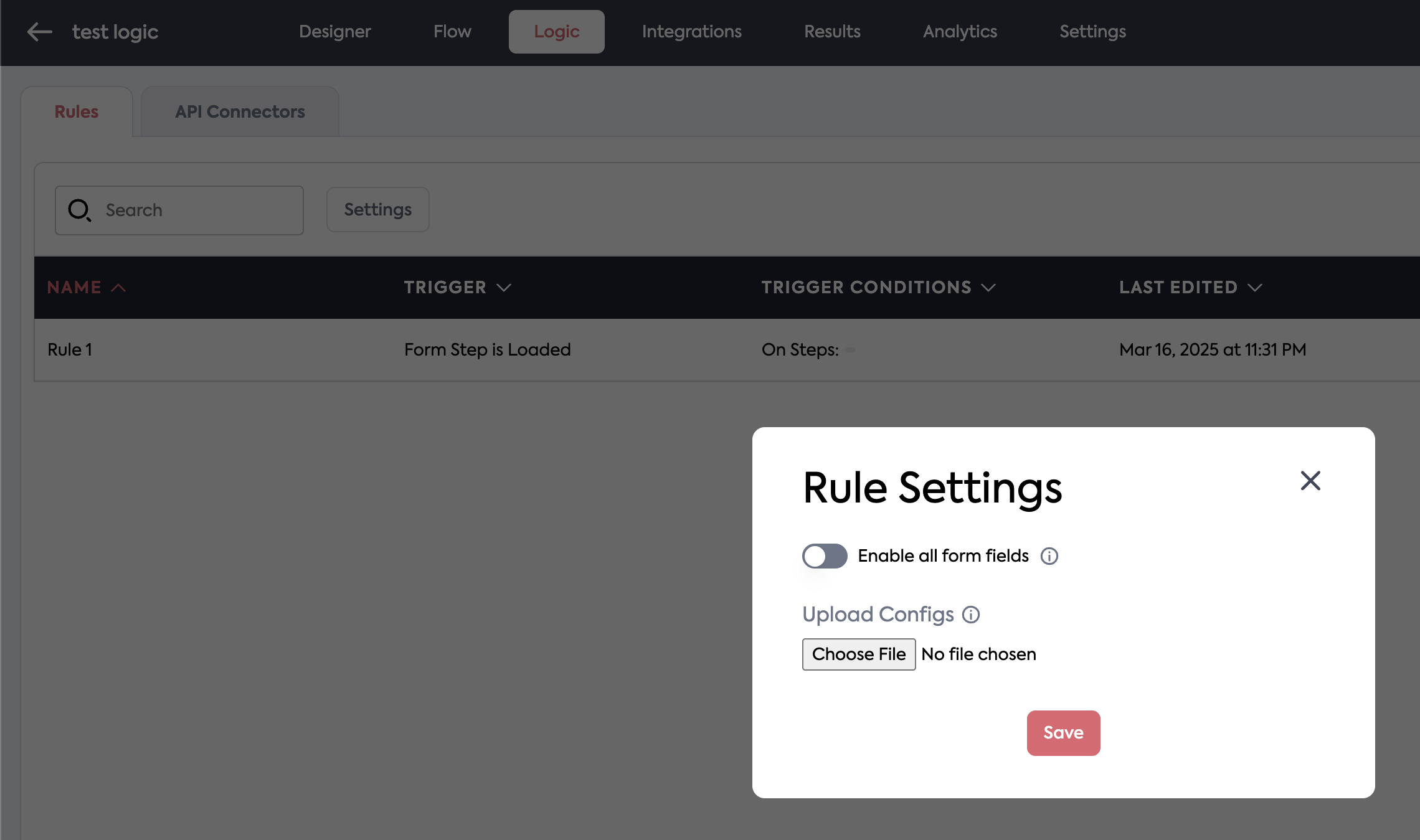
To set up a config, navigate to your form logic rules and click on the **Settings** button. This will open a pop-up that gives you an option to upload your config in CSV format. A typical workflow is:
1. Define your configuration in a spreadsheet (e.g. a list of stores by region, list of activities by time, etc). Make sure the first row of your CSV is a list of column headers.
2. Export the spreadsheet to a CSV and upload it to Feathery.
3. Feathery automatically stores and indexes your uploaded data, making it available to efficiently query from your rule itself. The data is formatted as an array of objects, where each object is a row of the spreadsheet that maps from a sepcific header to the value for that specific row and column.
## Use Configs in a Logic Rule
To use a config in your logic rule, you can leverage the `feathery.getConfig({filter, keys, unique})` method in your rule.
* `filter`: A map from spreadsheet headers to the values that rows being returned must contain. If not specified, all config values will be returned.
* `keys` : A list of spreadsheet columns to be returned. If not specified, all columns will be returned.
* `unique` : Only return spreadsheet rows with unique sets of values to be returned.
Make sure to `await` the promise returned from the method to get the actual values to use.
---
# Agent Instructions
This documentation is published with GitBook. GitBook is the documentation platform designed so that both humans and AI agents can read, navigate, and reason over technical content effectively. Learn more at gitbook.com.
## Querying This Documentation
If you need additional information that is not directly available in this page, you can query the documentation by asking a question.
Perform an HTTP GET request on the following URL with the `ask` and `goal` query parameters:
```
GET https://docs.feathery.io/platform/build-forms/advanced-logic/javascript-rule-builder/reusable-logic-configs.md?ask=&goal=
```
`ask` is the immediate question: it should be specific, self-contained, and written in natural language.
`goal` is what the user is ultimately trying to achieve, the reason they need the answer. Sharing it helps GitBook give you a better, more relevant answer. A goal is most helpful when it describes the outcome the user wants rather than restating the question. For example, with `ask=how do I create an API token`, a goal like `automate deployments from our CI pipeline` lets GitBook tailor the answer to that use case.
The response will contain a direct answer to the question and relevant excerpts and sources from the documentation.
Use this mechanism when the answer is not explicitly present in the current page, you need clarification or additional context, or you want to retrieve related documentation sections.