> For the complete documentation index, see [llms.txt](https://docs.feathery.io/llms.txt). Markdown versions of documentation pages are available by appending `.md` to page URLs; this page is available as [Markdown](https://docs.feathery.io/platform/launch-forms/ab-testing.md).
# A/B Testing
Run A/B tests natively in Feathery to optimize your user conversion rate and engagement.
Feathery supports the native ability to launch A/B tests to experiment with different form variants and evaluate conversion opportunities. We automatically route your users to different variants, track conversion analytics, and allow you to pick the winner of your experiments.
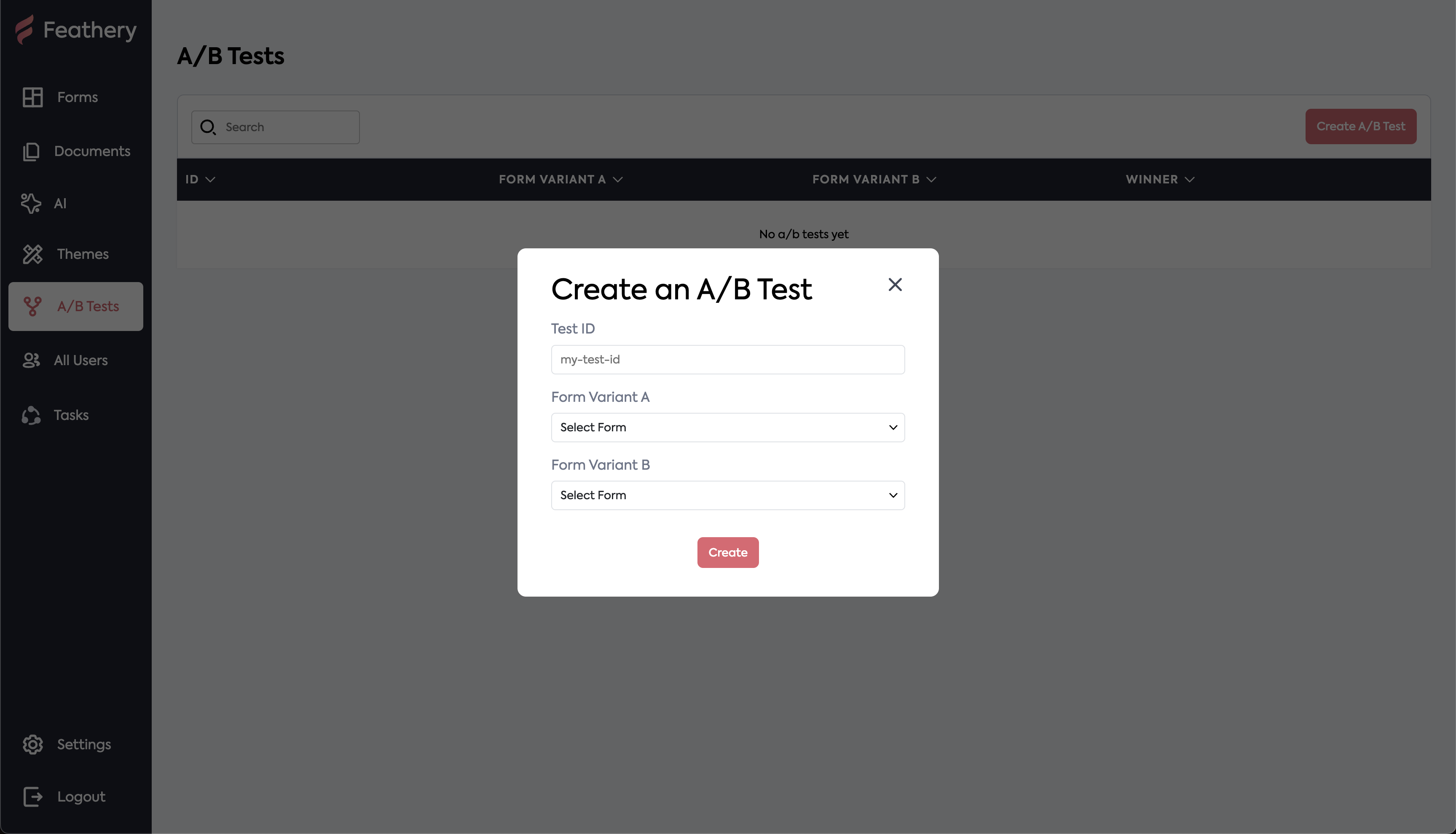
To launch an A/B test, go to the **A/B Tests** tab of your Feathery dashboard and click **Create A/B Test**. From this screen, specify a unique ID for the test and pick the two forms you would like to include in the experiment.
Once the test is live, accessing either of the form URLs or embeds will randomly serve either of the form variants to the end user. You can track performance analytics via Feathery's native form analytics or a third-party analytics tool that we have a native integration with, such as [Google Analytics](http://feathery.io/integrations/google-analytics), [Mixpanel](https://www.feathery.io/integrations/mixpanel), or [Amplitude](https://www.feathery.io/integrations/amplitude).
When you're ready to end your test, select the A/B test and choose the winner of the test. You may also optionally select the **Live Form** before pressing **Save**, which means the winning form of the test will automatically inherit the form URLs of the live form - whether that's the same form or the other form.
---
# Agent Instructions
This documentation is published with GitBook. GitBook is the documentation platform designed so that both humans and AI agents can read, navigate, and reason over technical content effectively. Learn more at gitbook.com.
## Querying This Documentation
If you need additional information that is not directly available in this page, you can query the documentation by asking a question.
Perform an HTTP GET request on the following URL with the `ask` and `goal` query parameters:
```
GET https://docs.feathery.io/platform/launch-forms/ab-testing.md?ask=&goal=
```
`ask` is the immediate question: it should be specific, self-contained, and written in natural language.
`goal` is what the user is ultimately trying to achieve, the reason they need the answer. Sharing it helps GitBook give you a better, more relevant answer. A goal is most helpful when it describes the outcome the user wants rather than restating the question. For example, with `ask=how do I create an API token`, a goal like `automate deployments from our CI pipeline` lets GitBook tailor the answer to that use case.
The response will contain a direct answer to the question and relevant excerpts and sources from the documentation.
Use this mechanism when the answer is not explicitly present in the current page, you need clarification or additional context, or you want to retrieve related documentation sections.